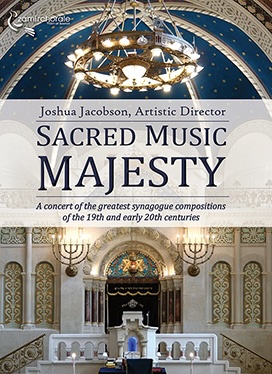
Our season finale, Sunday, June 7, 2026, 5-7:00 PM, at the Central Reform Temple, 15 Newbury Street in Boston, features renowned Cantor Josh Breitzer and Zamir’s own organist Edwin Swanborn for “Sacred Musical Majesty,” a concert of the greatest synagogue compositions of the 19th and early 20th centuries. Under the leadership of Zamir’s Artistic Director Josh Jacobson, the program also includes premiere performances of rediscovered liturgical masterworks by Cantor Helman Lieber, the late father of Frumie Lieber Burns, wife of Zamir tenor David Burns, and a dedication to Zamir board member, the late Dr. Bruce Donoff.
Cosponsors of the concert include David and Frumie Burns and Central Reform Temple.
For tickets, click here. See below for biographies and translations.
Biographies – Musical Performers
Joshua R. Jacobson, founder and director of the Zamir Chorale of Boston, served 45 years as Professor of Music and Director of Choral Activities at Northeastern University, including nine years as Music Department Chairman and six years as the Bernard Stotsky Professor of Jewish Cultural Studies. Prof. Jacobson is an internationally recognized expert on Jewish choral music and recipient of numerous awards. His book, Chanting the Hebrew Bible: The Art of Cantillation, published by the Jewish Publication Society in 2002 and issued in a revised edition in 2017, was a finalist for the National Jewish Book Award. He is co-author of Translations and Annotations of Choral Repertoire—Volume IV: Hebrew Texts, published by earthsongs in 2009. His monograph Salamone Rossi: Renaissance Man of Jewish Music, was published by Hentrich & Hentrich in 2016.
Cantor Josh Breitzer, soloist, is president of the American Conference of Cantors and has served Congregation Beth Elohim in Brooklyn since his 2011 ordination from Hebrew Union College. Named by The Forward as a leading voice of Jewish music, Cantor Breitzer has sung and taught in communities throughout North America and around the world. He proudly hails from mid-Michigan and spent formative summers at Interlochen Arts Camp, later earning degrees from the University of Michigan and the New England Conservatory. Cantor Breitzer is an instructor at HUC and on faculty at URJ Crane Lake Camp.
Edwin Swanborn, organist, studied with Dr. Anthony Newman at the Juilliard School of Music in New York, and has participated in master classes with Gustav Leonhardt and Anton Heiller. For fifty-six years, Mr. Swanborn was Music Director of the historic First Parish Church in Duxbury, Massachusetts. Before retiring, he was the Artistic Director of the Candlelight Concert Series of Duxbury, a nationally recognized chamber music series, Founder-Director of the Boston Baroque Chamber Players and harpsichordist of the Atlanta Virtuosi. Mr. Swanborn also served on the music staff of Northeastern University in Boston.
Maria Rindenello Spraker, harpist, currently holds the Principal Harp positions with the New Bedford Symphony Orchestra and the Vista Philharmonic Orchestra. She is an active freelancer in New England and studio recording artist for film and video game scores; and has performed with Boston Lyric Opera, Boston Modern Orchestra Project, Rhode Island Philharmonic, and Portland Symphony Orchestra (ME). Maria frequently performs with the Cape Symphony Orchestra, and also serves on faculty at the Cape Symphony’s Conservatory, teaching both harp and general music to students from preschool age to retirement age. She also maintains and repairs harps as a guild-certified harp technician.
Composers
Louis Lewandowski (1821-1894) came to Berlin as a choirboy, and within a few years had ascended to become director of all of Berlin’s synagogue choirs. His music is soundly based on the Hebrew liturgical texts, and musically interpreted through the German classical/romantic idiom of his time.
David Nowakowski (1848-1921) was born in Malin, near Kiev, then part of the Russian empire. In 1869 Nowakowski was offered the post of conductor at the newly built Brody Synagogue in Odessa. More than other Russian cities, Odessa was cosmopolitan, open to the cultural influence of Western Europe. The Brody synagogue in Odessa became known as a modern house of worship, with a renowned choir, cantor and organist.
Maier Kohn (1802-1875) was born in Schwabach, in Bavaria. At the age of 23 Kohn moved to Munich where he was named assistant cantor and organized a choir “for improving the standard of the divine service.” Kohn has the distinction of having been the first in Germany to abolish the irregular singing of ḥazzan and the “meshorerim” (informal choir) and to substitute a more modern musical service.
Helman Lieber (1904-1987) was born in Dvinsk, Latvia, on November 4, 1904, and arrived
in New York with his family the following year. Lieber learned cantorial skills at an early age from his father Ruben and his uncle Cantor David Lieber, who learned from his brother Cantor Boruch Lieber of Riga. Helman recalled, “I was a soprano soloist at the early age of six (1910) and was a drawing card in many concerts…I was known as ‘The Little Chazan.’” As a teenager and young man, Helman continued to perform as the soloist in the Lieber Synagogue Choir, organized by his uncle David, and featuring his father Ruben as choirmaster and his four younger brothers. The legacy of Cantor Lieber is a series of magnificently hand-written cantorial books, totaling more than 1,000 pages of detailed, meticulously scripted musical notation for completeShabbos, Rosh Hashanah, and Yom Kippur services, along with a generous number of miscellaneous selections. They were written by ear without the benefit of a piano or organ, and are believed to reflect cantorial melodies that were heard in the synagogues of Latvia in the late 1800s and early 1900s.
Albert Weill (1867-1950) served as cantor in Dessau, Germany, and composed a number of choral works for the worship there. In 1935 Weill and his wife Emma fled the Nazi regime and immigrated to Palestine. Weill’s fame today rests primarily on the distinction of being the father of the famous composer, Kurt Weill.
Giacomo Meyerbeer (1791-1864) was born as Jacob Leibmann Meyer Beer to a prominent Jewish family in Germany. After changing his name, he moved to Paris where he would become the most successful and wealthiest composer of his time. Meyerbeer wrote mostly operas, but in 1839 Meyerbeer composed a popular little song for girls’ voices called Prière d’Enfants – a children’s prayer. The Chief Cantor of Paris, Samuel Naumbourg (1817-1880), adapted this song and repurposed it with changed lyrics to serve as music for the liturgy of returning the Torah to the ark – Uvnukho Yomar.
Charles-Valentin Alkan (1813-1888), an eccentric French composer, was well known for his pianistic virtuosity. But less known is Alkan’s dedication to Judaism. Alkan grew up in a religiously observant Jewish household, and as an adult, was fluent in Hebrew, observed the laws of kashrut and was regarded as an authority on Jewish Music. He served briefly as organist at the great synagogue in Paris and contributed several compositions to cantor Samuel Naumbourg and his choir.
Jacques Halévy (1799-1862), the son of a Jewish cantor and essayist, composed music for more than 36 operas, including La Juive (1835) The Jewess, which was performed more than 500 times until the end of the 19th century. Unlike other artists whose parents were Jewish, Halévy did not hide his religious affiliation. Halévy was an active member of the Consistoire (the Jewish community organization), and composed several pieces for the Paris synagogue.
Salomon Sulzer (1804-1890) became the chief cantor of Vienna at the age of 23. In his time, he was famous for his sweet high baritone voice, his political activism and his extraordinary a cappella synagogue choir. But his legacy today consists of hundreds of liturgical compositions for cantor and choir bringing the styles of European music into the synagogue. His elaborate setting of Psalm 111, a joyous Hallelujah for chorus, cantor, organ and harp, was composed for a local prince’s birthday celebrations.
Translations
Mah Tovu (liturgy) (sung in Hebrew)
☆ Listen before the concert: https://youtu.be/gGNR100S6Uk
How good are your tents, O Jacob, your dwelling places, O Israel. (Numbers 24:5)
As for me, through Your abundant kindness, I will enter Your house;
I will bow down toward Your holy temple in awe of You. (Psalm 5:8)
O LORD, I love the house where You dwell, and the place where Your glory abides. (Psalm 26:8)
As for me, I will bow down and prostrate myself;
I will kneel before the LORD my Maker. (Psalm 95:6)
May my prayer to You, O LORD, be at a favorable time;
O God, in Your great faithfulness, answer me with the truth of Your salvation. (Psalm 69:14)
Ladonoy Ho-orets (Psalm 24) (sung in Hebrew)
☆ Listen before the concert: https://youtu.be/M_oMBCZLP14
The earth is the LORD’S and all that it holds, the world and its inhabitants.
For He founded it upon the ocean, set it on the nether-streams.
Who may ascend the mountain of the LORD? Who may stand in His holy place?
He who has clean hands and a pure heart,
who has not taken a false oath by My life or sworn deceitfully.
He shall carry away a blessing from the LORD, a just reward from God, his deliverer.
Such is the circle of those who turn to Him, Jacob, who seek Your presence. Selah.
O gates, lift up your heads! Up high, you everlasting doors,
so the King of glory may come in!
Who is the King of glory? The LORD, mighty and valiant, the LORD, valiant in battle.
O gates, lift up your heads! Lift them up, you everlasting doors,
so the King of glory may come in!
Who is the King of glory? The LORD of hosts, He is the King of glory! Selah.
Tov Lehodos (Psalm 92) (sung in Hebrew)
☆ Listen before the concert: https://youtu.be/HZkg2O8qhxU
It is good to praise the LORD, to sing hymns to Your name, O Most High,
To proclaim Your steadfast love at daybreak, Your faithfulness each night
With a ten-stringed harp, with voice and lyre together
You have gladdened me by Your deeds, O LORD; I shout for joy at Your handiwork.
How great are Your works, O LORD, how very subtle Your designs!
A brutish man cannot know, a fool cannot understand this:
though the wicked sprout like grass, though all evildoers blossom,
it is only that they may be eventually destroyed forever.
But You, O LORD, are exalted for all time.
Surely, Your enemies, O LORD, surely, Your enemies perish, all evildoers scattered.
You raise my horn high like that of a wild ox; I am soaked in refreshening oil.
I shall see the defeat of my watchful foes, hear of the downfall of the wicked who beset me.
The righteous bloom like a date-palm; they thrive like a cedar in Lebanon;
planted in the house of the LORD, they flourish in the courts of our God.
In old age they still produce fruit; they are full of sap and freshness,
attesting that the LORD is upright, my rock, in whom there is no wrong.
Enosh (Psalm 103: 15-17) (sung in Hebrew)
☆ Listen before the concert: https://youtu.be/9tqBa4jgi4I
Humans, their days are like those of grass; they blooms like a flower of the field;
a wind passes by and it is no more, its own place no longer knows it.
But the LORD’S steadfast love is for all eternity toward those who fear Him,
and His beneficence is for the children’s children
Aus den Tiefen (Psalm 130) (sung in German)
Out of the depths I call You, O LORD.
O Lord, listen to my cry; let Your ears be attentive to my plea for mercy.
If You keep account of sins, O LORD, Lord, who will survive?
Yours is the power to forgive so that You may be held in awe.
I look to the LORD; I look to Him; I await His word.
I am more eager for the Lord than watchmen for the morning, watchmen for the morning.
O Israel, wait for the LORD; for with the LORD is steadfast love and great power to redeem.
It is He who will redeem Israel from all their iniquities.
Ewiger (Psalm 36:6-11) (sung in German)
☆ Listen before the concert: https://youtu.be/p_jpTQP_LNE
O LORD, Your faithfulness reaches to heaven; Your steadfastness to the sky;
Your beneficence is like the high mountains; Your justice like the great deep;
You deliver both man and beast, O LORD. How precious is Your faithful care, O God!
Humans shelter in the shadow of Your wings. They feast on the rich fare of Your house;
You let them drink at Your refreshing stream.
With You is the fountain of life; by Your light do we see light.
Bestow Your faithful care on those devoted to You,
and Your beneficence on the upright.
Adonoy Zekhoronu (Psalm 115:12-18) (sung in Hebrew)
☆ Listen before the concert: https://youtu.be/0Vs0O518R90
The LORD is mindful of us. He will bless us;
He will bless the house of Israel; He will bless the house of Aaron;
He will bless those who fear the LORD, small and great alike.
May the LORD increase your numbers, yours and your children’s also.
May you be blessed by the LORD, Maker of heaven and earth.
The heavens belong to the LORD, but the earth He gave over to man.
The dead cannot praise the LORD, nor any who go down into silence.
But we will bless the LORD now and forever.
Hallelujah.
Se’u Zimro (Psalm 81:3-5) (sung in Hebrew)
Take up the song, sound the timbrel, the melodious lyre and harp.
Blow the horn on the new moon, and on the full moon for our feast day.
For it is a law for Israel, a ruling from the God of Jacob.
Ve’al Yedey Avodekho (liturgy) (sung in Hebrew)
And Your faithful servants wrote, “The is what the LORD declares.”
Go proclaim to Jerusalem, “Thus said the LORD.” (Jeremiah 2:2)
I remember the devotion of your youth, your love as a bride –
how you followed me in the wilderness, in a land, not sown.
I will remember the covenant I made with you in the days of your youth,
and I will establish it with you as an everlasting covenant. (Ezekiel 16:60)
Is Ephraim not a dear son to me, a child in whom I delight?
Even when I speak against him, I still remember him.
That is why My heart yearns for him; I have great compassion for him. (Jeremiah 31:20)
Veshomeru (Exodus 31:16-17) (sung in Hebrew)
The Israelite people shall keep the Sabbath,
observing the Sabbath throughout the ages as a covenant for all time.
It shall be a sign for all time between Me and the people of Israel.
For in six days the LORD made heaven and earth,
and on the seventh day He ceased from work and was refreshed.
Khatsi Kaddish (liturgy) (sung in Aramaic and Hebrew)
Glorified and sanctified be God’s great name throughout the world,
which He has created according to His will.
May He establish His kingdom in your lifetime and during your days,
and within the life of the entire House of Israel, speedily and soon, and say, Amen.
May His great name be blessed forever and to all eternity.
Blessed and praised, glorified and exalted, extolled and honored,
adored and lauded be the name of the Holy One, blessed be He,
beyond all the blessings and hymns, praises and consolations that
are ever spoken in the world; and say, Amen
Eyn Keloheynu (liturgy) (sung in Hebrew)
There is none like our God, there is none like our Lord,
There is none like our King, there is none like our Savior.
Who is like our God? Who is like our Lord?
Who is like our King? Who is like our Savior?
Let us thank our God, Let us thank our Lord,
Let us thank our King, Let us thank our Savior.
Blessed be our God, Blessed be our Lord,
Blessed be our King, Blessed be our Savior.
You are our God, You are our Lord,
You are our King, You are our Savior.
Uvnukho Yomar (liturgy) (sung in Hebrew)
When the ark was set down, Moses prayed,
O LORD, return to the many thousands in Israel.” (Numbers 10:36)
Come up, O LORD, to your residence, You along with the ark of Your might. (Psalm 132:8)
May Your priests be clothed in righteousness,
and may Your faithful ones sing for joy. (Psalm 132:9)
For the sake of Your servant, David,
do not reject the presence of Your anointed one. (Psalm 132:10)
I have given you good guidance; do not forsake My teaching. (Proverbs 4:2)
It is a tree of life to those who cling to it, fortunate are they who uphold it. (Proverbs 3:18)
Its ways are ways of pleasantness, and all its paths are peaceful. (Proverbs 3:17)
Turn us back to you, O LORD, that we may return.
Renew our days as before. (Lamentations 5:21)
Halleluyoh (Psalm 150) (sung in Hebrew)
☆ Listen before the concert: https://youtu.be/7ozp4Sx8Xhg
Hallelujah.
Praise God in His sanctuary; praise Him in the sky, His stronghold.
Praise Him for His mighty acts; praise Him for His exceeding greatness.
Praise Him with blasts of the horn; praise Him with harp and lyre.
Praise Him with drum and dance; praise Him with lute and pipe.
Praise Him with resounding cymbals; praise Him with loud-crashing cymbals.
Let all that breathes praise the LORD.
Hallelujah.
Somakhti (Psalm 122) (sung in Hebrew)
☆ Listen before the concert: htthttps://youtu.be/oRA740Gy1NA
I rejoiced when they said to me, “We are going to the House of the LORD.”
Our feet stood inside your gates, O Jerusalem, Jerusalem built up, a city knit together,
to which tribes would make pilgrimage,
the tribes of the LORD, —as was enjoined upon Israel—to praise the name of the LORD.
There the thrones of judgment stood, thrones of the house of David.
Pray for the well-being of Jerusalem; “May those who love you be at peace.
May there be well-being within your ramparts, peace in your citadels.”
For the sake of my kin and friends, I pray for your well-being;
for the sake of the house of the LORD our God, I seek your good.
Halleluyoh (Psalm 111) (sung in Hebrew)
☆ Listen before the concert: https://youtu.be/O_aqCR78C90
Hallelujah.
I praise the LORD with all my heart in the assembled congregation of the upright.
The works of the LORD are great, within reach of all who desire them.
His deeds are splendid and glorious; His beneficence is everlasting;
He is acclaimed for His wonders. The LORD is gracious and compassionate;
He gives food to those who fear Him; He is ever mindful of His covenant.
He revealed to His people His powerful works, in giving them the heritage of nations.
His handiwork is truth and justice;
all His precepts are enduring, well-founded for all eternity, formed of truth and equity.
He sent redemption to His people; He ordained His covenant for all time;
His name is holy and awesome.
The beginning of wisdom is the fear of the LORD; all who practice it gain sound understanding.
Praise of Him is everlasting.

Write a Tribute